

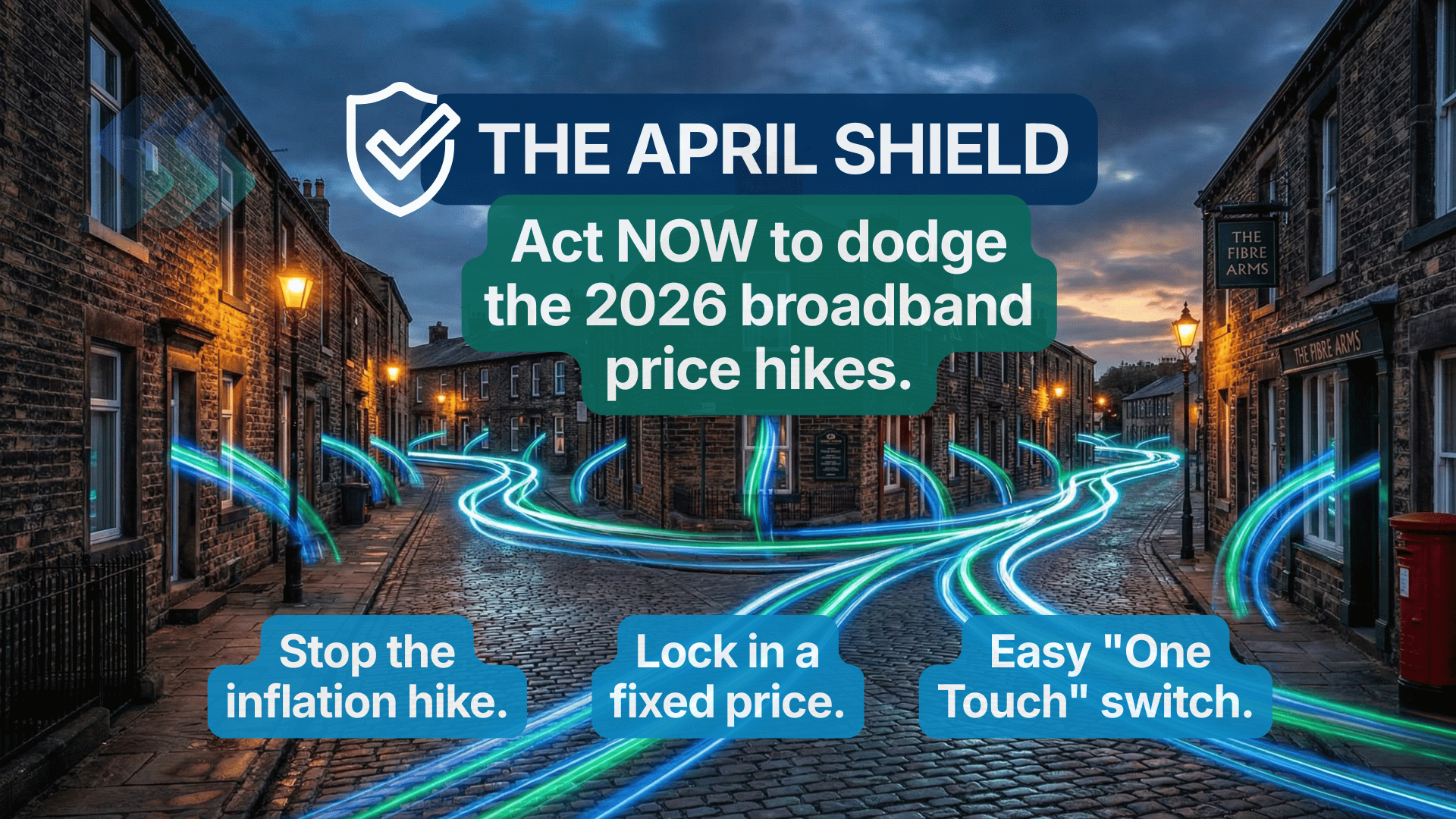
In three months, your broadband bill is likely going up. Again.
It is not because you used more data. It is not because your speed increased. It is because of a clause buried in the small print of millions of UK broadband contracts. This is the annual “inflation plus” adjustment, and it typically hits in April.
Most consumers accept this as inevitable. It is not.
You can adopt a strategy I call “The April Shield.” By making a specific type of switch in January, you can legally opt out of the upcoming price rise cycle or minimise its impact significantly.
Here is how the math works and how you can protect your household budget before the letters start arriving.
When do broadband prices go up in 2026?
Many major providers include a term in their contracts that allows them to increase your monthly price every April. They calculate this based on the Consumer Prices Index (CPI) or Retail Prices Index (RPI) published in January, plus an extra percentage—often 3.9%.
This means even if inflation is low, your bill goes up. If inflation is high, your bill goes up significantly.
Why this matters now:
The relevant inflation figures are published in January. Once those numbers are public, providers calculate the increase. If you are out of contract, or in a contract with these terms, you will pay that new price from April 2026.
Strategy 1: The Fixed Price Promise
The most effective layer of the April Shield is moving to a provider that explicitly guarantees no mid-contract price rises.
While the largest names often use the inflation-plus model, many challenger brands and alt-nets (alternative networks) use fixed pricing as a competitive advantage. They promise that the price you sign up for is the price you pay for the full duration of the term, usually 18 or 24 months.
The Math:
- Provider A (Standard): £30/month. April hike adds approx £2.50. Total cost over remaining 12 months increases by £30.
- Provider B (Fixed): £30/month. Stays £30/month.
You save money purely by stability.
Consumer Warning
“Fixed Price” must be stated in the terms. Do not assume a deal is fixed just because the marketing doesn’t mention a rise. Always check the “offer details” or “legal bits” before you click buy.
Strategy 2: The 30-Day Rolling Contract
If you are a renter, a student, or simply plan to move house in 2026, a long-term fixed contract might be too rigid.
The alternative shield is the 30-day rolling contract.
- Pros: You can leave with 30 days’ notice if they announce a price hike. You have total leverage.
- Cons: The monthly fee is often slightly higher, and setup fees may apply.
This approach works best if you value flexibility over the absolute lowest monthly rock-bottom price. You can compare 30-day rolling contracts alongside standard deals to see the difference.
How to execute “The April Shield”
You do not need to call your current provider and argue. The switching process handles the heavy lifting.
- Check your status. Are you out of contract? If yes, you are free to leave without penalty. If you are mid-contract, check your exit fee. Sometimes the savings from a cheaper deal outweigh the exit fee, but you must calculate this first.
- Filter for “Fixed Price” or “No Hikes.” When you compare current broadband packages, look for providers that highlight a fixed price promise.
- Validate the speed. Run a speed test on your current connection so you know what baseline you need to match or beat.
- Start the switch. In most cases, the new provider notifies the old one. If you are switching networks (e.g., from Openreach to an independent fibre network), you may need to cancel the old service manually once the new one is active.
Worked Example: The Walker Household
The Walkers pay £45 a month for standard fibre. They are out of contract.
- If they do nothing: Their provider applies a 7% rise (hypothetical CPI + 3.9%). New bill: £48.15. Annual cost: £577.80.
- The Switch: They move to a full fibre option costing £35 a month with a fixed price promise.
- The Result: They save £10 immediately, plus they avoid the £3.15 hike. Total annual saving: over £150.
Your Consumer Rights
Confusion regarding rights stops many people from switching. Here is the reality of the regulations.
- Cooling-off period: When you buy online, you typically have 14 days to change your mind and cancel without penalty.
- Right to exit: If a provider raises prices higher than what they agreed in your contract (i.e., they didn’t warn you about the CPI+3.9% formula), you can usually leave penalty-free within 30 days of the notification.
- The “One Touch” Switch: For many switches between major networks, the new “One Touch” regulation means you only need to talk to the new provider. They handle the transfer and the cancellation.
The Manual Way vs. The Easy Way
You could visit ten different provider websites, dig through the footer links, find the “Legal” page, and read the Terms & Conditions PDF to find their inflation policy.
Or, you can view the market in one place.
We group deals by total cost and feature set, helping you spot the fixed-price offers instantly.
Check availability and lock in your price
Frequently Asked Questions
Can I switch if I am mid-contract?
Yes, but you will likely pay an early termination fee. This is usually calculated based on the months remaining on your contract. Compare this fee against your potential savings.
Do all providers increase prices in April?
No. Several providers, particularly smaller independent networks and some budget brands, offer fixed-price contracts.
Will I lose internet during the switch?
For most switches on the Openreach network, the downtime is minutes. If you are switching to a separate cable or alt-net infrastructure, you can have both running simultaneously for a day to ensure zero downtime.
Is full fibre more expensive?
Not always. Because providers want to move customers off old copper lines, full fibre deals are often priced very competitively to encourage the switch.
Correct as of January 2026. Deals and availability vary by address. Prices change. Check the provider’s current terms. Switching timelines vary. Cooling-off rights may apply depending on how you buy. See Industry news for more updates.
Broadband #MoneySaving #CostOfLivingUK #PersonalFinance #Budgeting